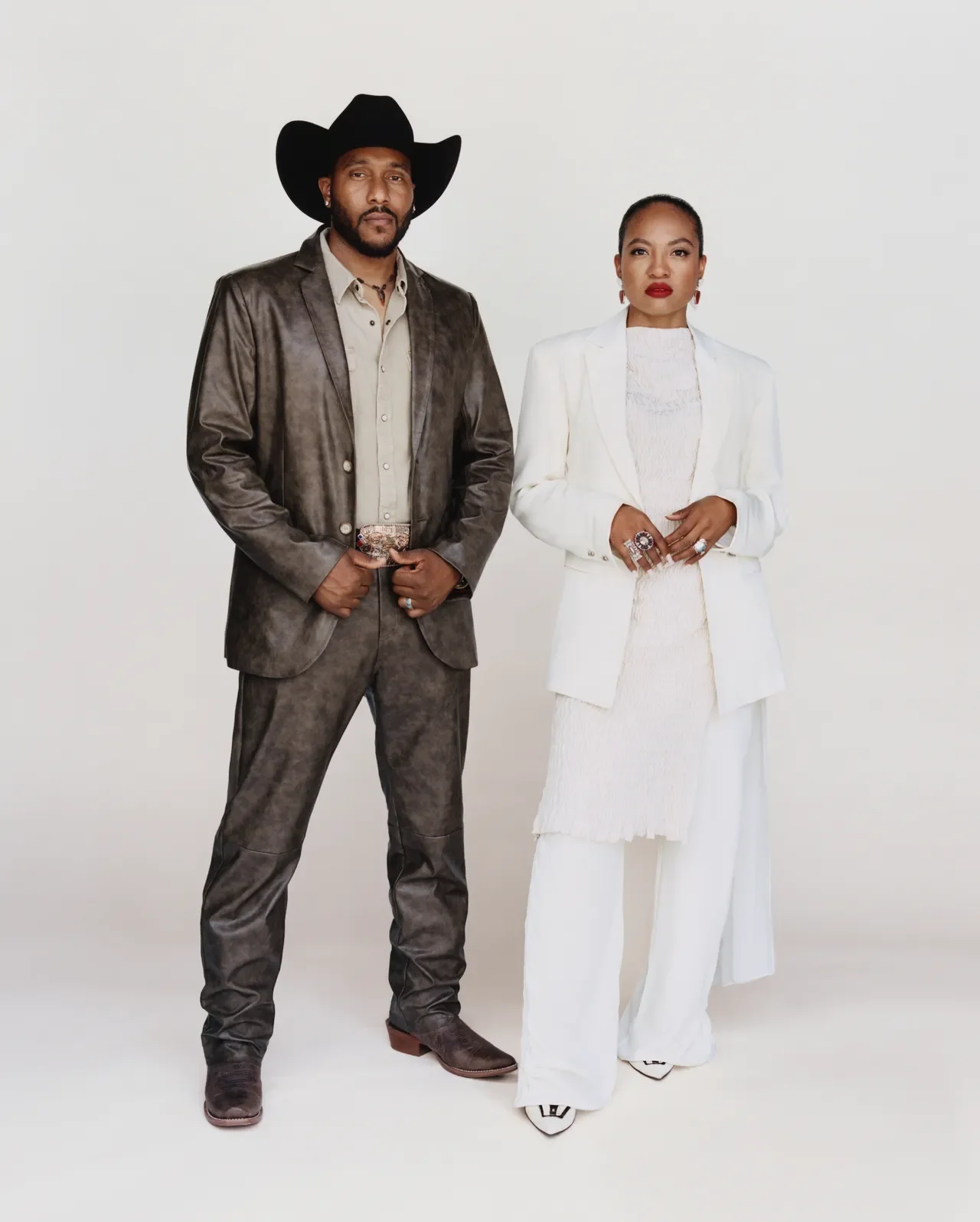
Third-generation cowboy Dennis Chachere in a KidSuper suit. His wife, entrepreneur Ahsaki Chachere, in Campillo.
Director @5tvrr
Director of Photography @the_constantine_lens
Editors @evan.allan @__katiewolford__
Senior Producer @baity_dee
Producers @gigi.chavarria @michbruno
Associate Producer @leadonenberg
1st Assistant Camera @thesaddiestmeme
Gaffer: Durwin Joseph
Audio @mariyachuli
Portfolio Photographer @tylersphotos
Fashion Editor @mr_carlos_nazario
Filmed on Location @texassouthern St. Joseph's Church @brunostriangleseven @neonboots_club @bigbendnps
Special Thanks @tsuoceanofsoul @charrasdeaguasanta Community of Faith Voices of Faith Choir
What began as an opportunity for Dennis and Ahsaki Chachere became a moment for Houston’s Black rodeo community, its cowboys and a legendary family arena.
Some opportunities arrive as recognition.
Others arrive with a responsibility.
When Dennis and I received the call to participate in Vogue’s Summer 2026 Texas portfolio, we understood immediately that the moment could not begin and end with us.
Yes, it was our first Vogue shoot. It was a milestone we had prayed for and worked toward. But our journey had never existed separately from the cowboys, families, horses and arenas that shaped us.
If Vogue wanted to see our Western world, we wanted them to see more than two people standing inside it.
We wanted to open the door wider.
Bigger Than Dennis and Me
Western culture is not something Dennis and I discovered through fashion. It is part of our everyday lives our work, our family, our relationships and the communities that have carried us.
The arena has always represented more than competition. It is where families gather, young riders learn, horses are trained and traditions move from one generation to the next.
That entire world could not be represented honestly through Dennis and me alone.
We wanted the Vogue opportunity to include the people and places that gave our story its foundation. Not as background. Not as props. Not as anonymous figures placed around us to make a photograph feel authentic.
They deserved to be recognized as part of the story.
Opening the Arena
Anthony J. Bruno opened his family’s Bruno’s Triangle Seven Rodeo Arena to the production.
That decision gave the shoot more than a beautiful location. It gave it history.
Bruno’s is one of Houston’s only Black-owned rodeo arenas a space built through family, community and a commitment to preserving Black Western culture. Its fences, horses and weathered structures hold the evidence of a living tradition.
Cowboys and Cowgirls from the Bruno’s community became part of Vogue’s finished Texas portfolio.
The world did not simply see Dennis and me connected to rodeo. It saw a larger community of people who live it.
That was the purpose of opening the door.
The Arena Was Never a Backdrop
The setting mattered because it was real.
This was not a fashion set constructed to resemble the West. It was an active arena shaped by the people who ride, train, compete and gather there.
The horses were not accessories. The cowboys were not atmosphere. The arena was not simply a rustic background behind beautiful clothing.
Every element carried meaning.
When fashion entered that space, it encountered a culture that was already complete. Vogue did not give the arena its significance. The photographs allowed a larger audience to witness the significance that had always been there.
Black Cowboys Have Always Been Here
Black Western culture is sometimes treated as a new discovery, but Black cowboys are not new.
They have always been part of the American West.
They have raised horses, competed in rodeos, built arenas and created spaces where their families could gather and continue the tradition. Their histories did not begin when mainstream fashion became interested in cowboy imagery.
That is why visibility matters.
Vogue’s “Lone Star State of Mind: Snapshots of Texas Today”, photographed by Tyler Mitchell and styled by Carlos Nazario, placed members of this living rodeo community within a broader portrait of Texas.
The feature did not introduce Black cowboys to the West.
It introduced more of the world to cowboys who were already here.
What Opening the Door Really Means
Opening the door wider does not diminish your own moment.
It gives the moment greater meaning.
Dennis and I will always be grateful for the opportunity to be part of Vogue. But what makes the experience most meaningful is knowing that the call did not stop with us.
It reached an arena.
It reached working cowboys.
It reached a Black Western family legacy.
It reached a community that deserved to be seen in its own environment and on its own terms.
The honor was being invited through the door.
The responsibility was making sure we did not walk through it alone.
Photography: Tyler Mitchell
Fashion Editor: Carlos Nazario
Featured Location: Bruno’s Triangle Seven Rodeo Arena
Published in: Vogue, Summer 2026