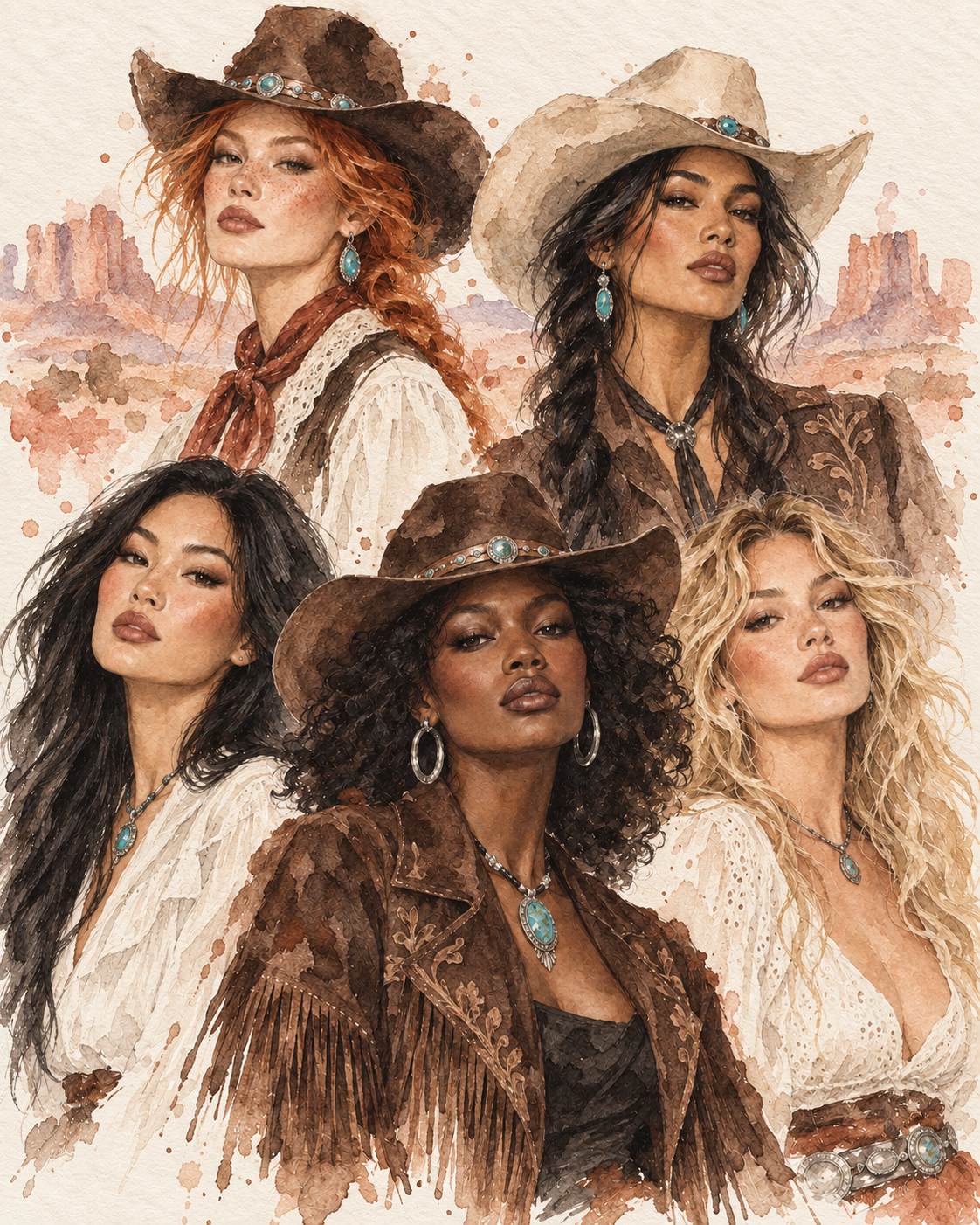
Western beauty was never one look.
The face of the West has never been singular.
It has always existed in different hues, features, histories and expressions though the images traditionally associated with Western beauty have rarely shown its complete range.
Look beyond the familiar frame and another portrait emerges.
It is found in sun warmed skin and deep complexions. In freckles, full lips, prominent cheekbones, soft curves and angular profiles. It is reflected in loose waves, natural curls, long braids and strands left untamed by the wind.
Some women wear the cowboy hat. Others do not need one to prove that they belong.
Western beauty is not created by a costume. It comes from identity, environment and an unmistakable sense of self.
BEAUTY WITH HISTORY
Throughout the West, beauty has carried meaning beyond appearance.
Hair can hold memory. Jewelry can signal heritage. A shade of red can express confidence, while turquoise and silver can connect generations. These details are not simply accessories they are part of the visual language through which women tell the world who they are.
The modern Western woman does not have to abandon that history to evolve. She can protect what was passed down while deciding how it will be worn next.
THE COLORS OF THE LAND
Western beauty draws naturally from its surroundings.
Terracotta recalls the earth. Copper catches the evening light. Warm browns, desert rose, weathered gold and deep oxblood reflect a landscape that is both rugged and romantic.
On the face, these colors become softly smoked eyes, sunlit cheeks and lips ranging from understated nude to commanding red. The most compelling beauty does not conceal the woman beneath it. It brings her forward.
BEYOND ONE IMAGE
For too long, the Western woman was presented through a narrow lens as though one complexion, one body and one kind of femininity could represent an entire culture.
But the West has always been shaped by Native, Black, Latina, Asian, Native Hawaiian, Pacific Islander and white women ranchers, riders, artists, founders, mothers and women whose work was essential even when their names were left outside the story.
Representation is not about placing unfamiliar faces into the West. It is about finally recognizing the women who were already here.
A cowboy hat may frame the face, but it does not create the identity. There is no single way to look Western only the freedom to define it for yourself.
The new face of the West is not one face at all. It is every shade, every shape and every story that makes the landscape whole.
It is ancestral and evolving.
Soft and formidable.
Rooted and still moving forward.