Rodeo for Beginners: Welcome to the Arena
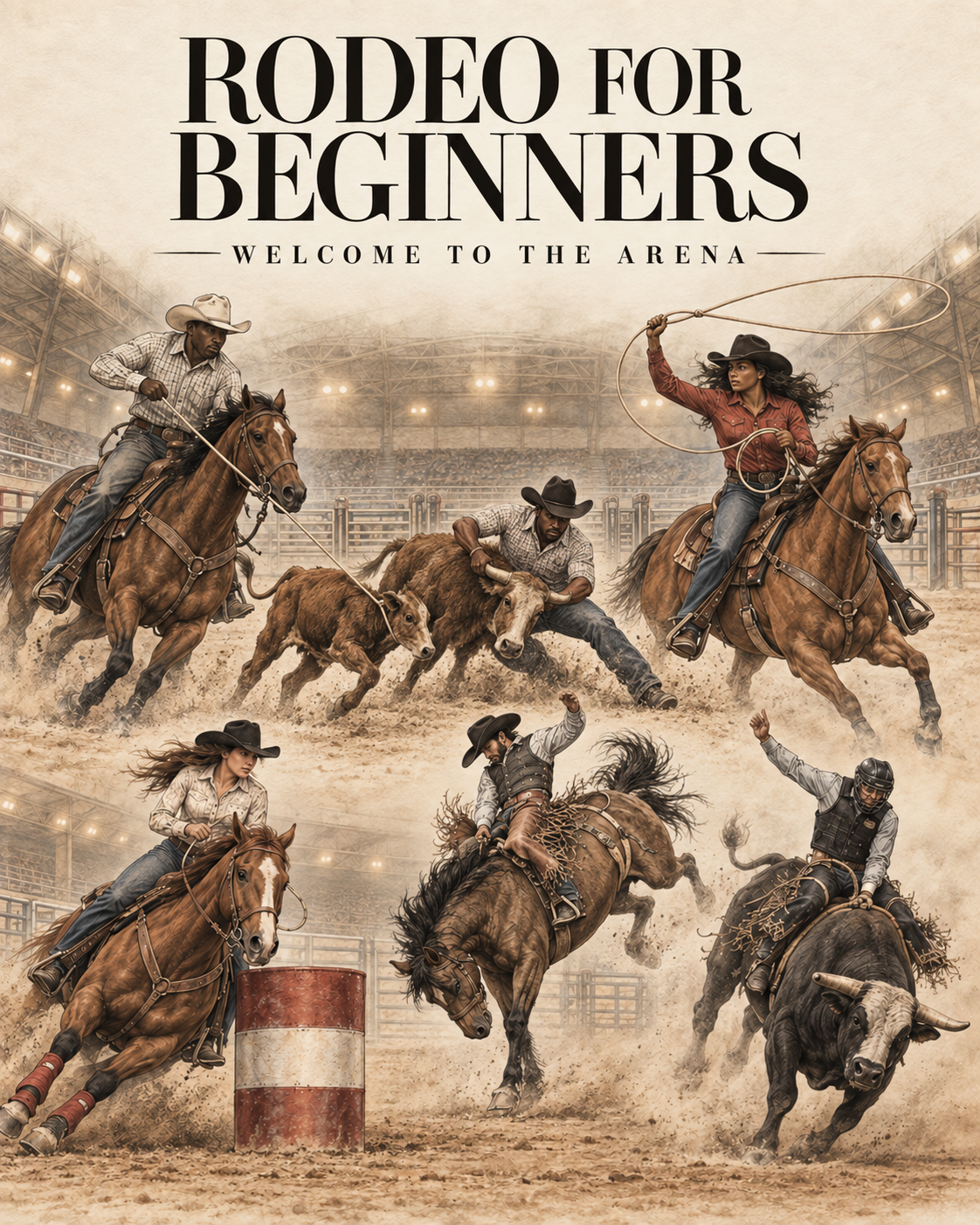
New to rodeo? Consider this your quick introduction to the events, athletes and traditions you’ll see during championship season.
You do not have to grow up around horses, know every champion’s name or understand every rule to become a rodeo fan.
You only have to start watching.
With the 2026 Wrangler National Finals Rodeo approaching, this is the perfect time for new fans to learn what is happening inside the arena. Rodeo moves quickly, but once you understand the events and a few key terms, every run and ride becomes more exciting.
First, What Is the NFR?
The Wrangler National Finals Rodeo is professional rodeo’s championship event the Super Bowl of the sport.
The top 15 qualifying contestants in each event travel to Las Vegas for ten consecutive rounds of competition. They compete for nightly prize money while continuing their pursuit of a world championship.
The 2026 NFR takes place December 3–12 at the Thomas & Mack Center in Las Vegas. Each performance begins at 5:45 p.m. Pacific Time. View the official NFR schedule.
The Seven NFR Events—Plus Breakaway Roping
Rodeo is divided into two main categories: timed events and roughstock events.
In timed events, the fastest qualified time wins. In roughstock events, the contestant must complete an eight-second ride and is judged on both their performance and the animal’s performance.
Bareback Riding
A cowboy rides a bucking horse without a saddle, holding onto a leather rigging with one hand.
The rider must remain aboard for eight seconds, keep their free hand from touching the horse or equipment and demonstrate control through their spurring motion. The cowboy and horse are each awarded up to 50 points, creating a possible total score of 100.
Steer Wrestling
Also known as bulldogging, steer wrestling is exactly as physical as it looks.
The cowboy rides alongside a running steer, leaves the horse, catches the steer by the horns and brings it to the ground. The clock stops when the steer is on its side with all four legs pointing in the same direction.
The fastest qualified time wins.
Team Roping
Team roping is the only NFR event featuring two contestants working together.
The header ropes the steer first, usually around the horns, neck or both. The header then turns the steer so the heeler can rope both hind feet.
The clock stops when the horses face one another and the ropes are tight. Catching only one hind leg adds a five-second penalty.
Saddle Bronc Riding
Often called rodeo’s classic event, saddle bronc riding grew from the work of breaking and training horses on Western ranches.
The cowboy rides a bucking horse for eight seconds using a specialized saddle and one rein. Judges look for control, balance, rhythm and spurring technique while also scoring the strength of the horse’s performance.
Like bareback riding, the highest possible score is 100 points.
Tie-Down Roping
A mounted cowboy gives a calf a head start, ropes it, dismounts and runs down the rope. The cowboy then lays the calf on its side and ties three legs together using a short rope called a piggin’ string.
After the contestant remounts and creates slack in the rope, the tie must remain secure for six seconds.
This event is built around timing, horsemanship and teamwork between the cowboy and the horse. A great tie-down horse knows when to stop, keep the rope tight and give the roper space to work.
Breakaway Roping
Breakaway roping is one of the fastest events in rodeo—and the ladies make every second count.
A mounted roper gives the calf its required head start before racing out of the box and throwing a loop around its neck. Unlike tie-down roping, the contestant does not dismount or tie the calf.
Instead, the rope is secured to the saddle horn with a small string. When the horse stops and the calf reaches the end of the rope, the string breaks away from the saddle horn, signaling the end of the run. The fastest qualified time wins, and championship runs can be completed in just a few seconds.
Although breakaway roping is not currently one of the seven events contested at the NFR inside the Thomas & Mack Center, the top women compete for their own world championship at the Wrangler WPRA National Breakaway Finals.
Formerly held at South Point Arena in Las Vegas, the championship moves to Will Rogers Coliseum in Fort Worth, Texas, for 2026. Competition takes place December 18–19, with doors opening at 6:00 p.m. and the action beginning at 7:00 p.m. each night. View the official event and ticket information.
Barrel Racing
In barrel racing, a horse and rider race around three barrels arranged in a cloverleaf pattern before sprinting back across the finish line.
The fastest time wins, but knocking over a barrel adds a five-second penalty. A wide turn can cost valuable time, while cutting too close can bring a barrel down.
Watch the horse’s approach, the rider’s positioning through each turn and the final run home. Fractions of a second can separate first place from the rest of the field.
Bull Riding
Bull riding is often the event that first captures a new fan’s attention.
The cowboy must remain on a bucking bull for eight seconds using one hand on a braided rope. Touching the bull or the equipment with the free hand results in disqualification.
The rider receives points for control and style, while the bull is judged on its power, speed, direction changes and difficulty. Together, they can earn a maximum score of 100 points.
Rodeo Words You Will Hear
Go-round: One complete round of competition. The NFR has ten go-rounds.
Draw: The animal randomly assigned to a contestant. Because every animal performs differently, the draw can greatly affect a ride.
Qualified ride: A completed roughstock ride that meets the rules and lasts eight seconds.
No time: A timed-event run that does not receive an official time because the contestant did not complete the run correctly.
Aggregate: A contestant’s combined time or score across multiple rounds. At the NFR, consistency across all ten rounds is extremely valuable.
Barrier: The starting system that ensures the animal receives the required head start in certain timed events.
World standings: The season-long rankings based on official earnings.
What Should New Fans Watch For?
Do not focus only on who wins.
Watch how a horse positions itself during a tie-down or breakaway run. Notice the communication between a header and heeler. Listen for the crowd’s reaction when a roughstock animal explodes out of the chute. Pay attention to how quickly a barrel horse lowers its body and changes direction.
Rodeo is not simply about staying on or stopping the clock. It is a sport built on partnership, athleticism, instinct, preparation and respect for the animals.
The more closely you watch, the more you begin to see.
Welcome to Rodeo
Every longtime rodeo fan was once a beginner.
Ask questions. Choose a favorite event. Learn the contestants’ names. Celebrate the horses and livestock that make the sport possible. When the yellow chutes open in Las Vegas this December, you will understand a little more about what is on the line.
You do not have to know everything before entering the arena.
You are welcome here.