More Than Turquoise
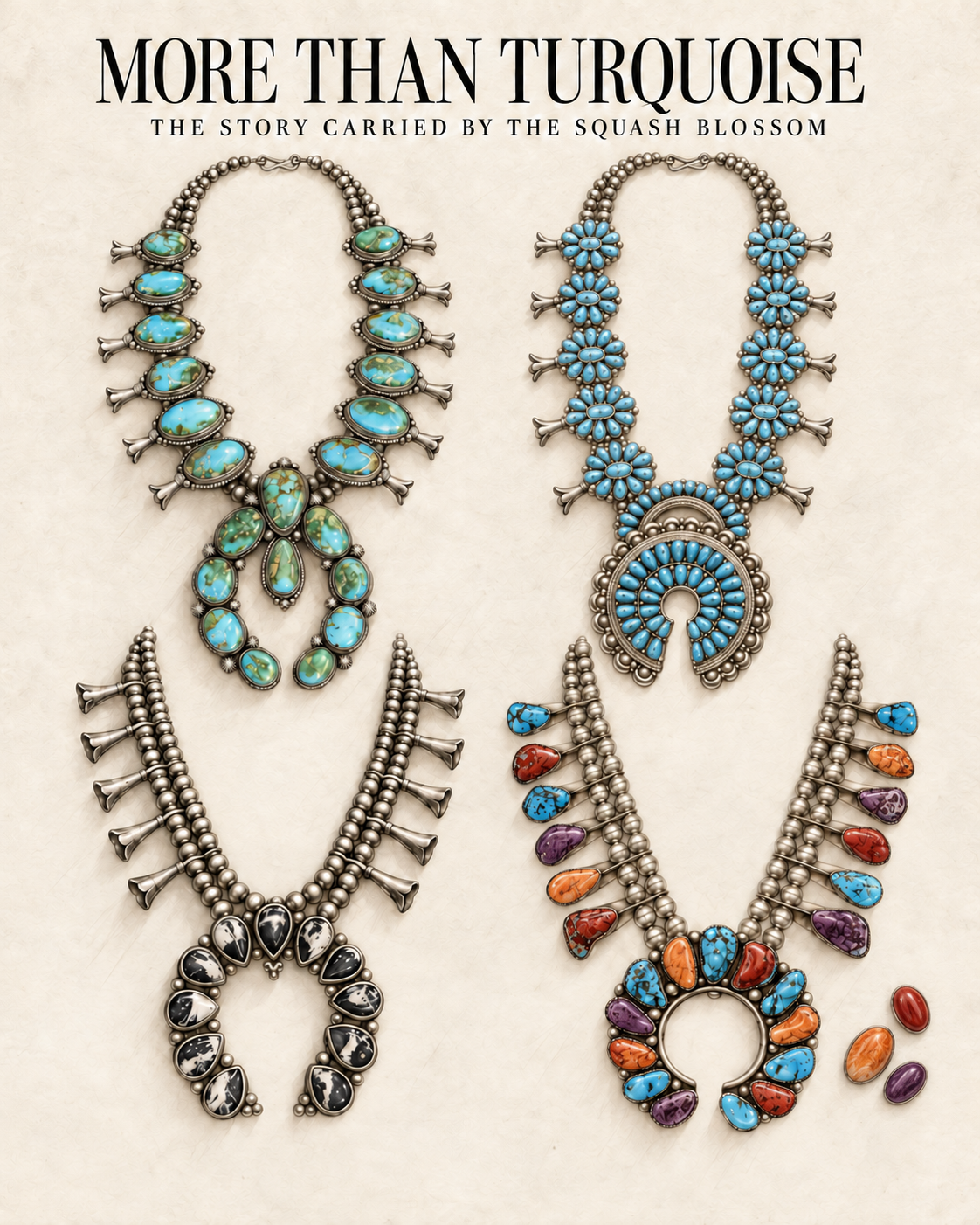
The Story Carried by the Squash Blossom
In Western fashion, the squash blossom necklace is often introduced as a statement piece. It is admired for its scale, silverwork and unmistakable presence. But before it became an editorial accessory or collector’s item, it was and remains an expression of Native artistry, cultural exchange and generations of knowledge.
The squash blossom is more than turquoise. It is more than silver. And it is far more than something chosen simply to complete an outfit.
The Stones Speak
Turquoise may be the stone most closely associated with squash blossom necklaces, but it is not used for color alone. Across the Southwest, turquoise has long been connected to water, sky, rain, health, protection, abundance and beauty. Native people of the region have used it ceremonially, medicinally and decoratively for generations. The Museum of Indian Arts and Culture describes turquoise as representing many elements of a good life.
Even the character of the stone tells a story. Some turquoise is bright blue. Some carries shades of green. Some is crossed with a dark or golden matrix created by the earth surrounding it. No two stones are exactly alike.
But turquoise is only part of the language.
Native jewelers also work with coral, shell, jet, spiny oyster and other stones and natural materials. Shell carries a relationship to water through its ocean origin, while turquoise, shell and jet have been associated with directional teachings by cultures throughout the region. These meanings are not identical across every Native nation, family or artist, and they should never be treated as one universal translation. The Museum of Indian Arts and Culture emphasizes that these materials carry distinct histories and cultural relationships.
Sometimes a stone holds collective cultural meaning. Sometimes it represents the vision of the artist. Sometimes its deepest value comes from the person who wore it before you.
Every Necklace Is Different
Squash blossom necklaces are not one fixed design. Some feature large natural stones with visible matrix. Others use precise needlepoint or cluster work. Some are made without turquoise at all, allowing silver or darker stones to shape the piece.
The naja the crescent shaped element often placed at the center can also change dramatically in size, construction and detail. Together, the blossoms, beads, stones and naja reveal the individual hand of the maker.
That individuality matters. A squash blossom should not be reduced to a generic “tribal” look. It is a work of art created through technical knowledge, artistic judgment and countless hours of labor. The Smithsonian’s National Museum of the American Indian recognizes distinctive Diné silver jewelry as part of the artistic knowledge carried forward through generations. Smithsonian NMAI
Appreciation, Not Costume
Native jewelry can be admired, purchased and worn by people from many backgrounds. Appreciation begins with understanding that these pieces are not props created to complete a Western costume. They come from living cultures, skilled Native artists and generations of knowledge.
Respect can look like learning who made the piece, naming the artist and tribal nation when that information is known, purchasing authentic Native made work and understanding the difference between an original creation and a mass produced imitation.
The line is crossed when Native jewelry is reduced to a trend, described vaguely as “tribal,” paired with stereotypes or worn as part of a costume that imitates Native identity. A squash blossom necklace should never erase the people whose artistry gave it life.
You do not have to be Native to appreciate or wear Native made jewelry. But you should wear it with respect not as though you are becoming someone else, but with an understanding of whose hands, history and creative tradition you are carrying.
What We Carry Forward
For many families, these necklaces become heirlooms. They are worn through celebrations, ceremonies, photographs and milestones before being entrusted to the next generation. Their value cannot always be measured by the weight of the silver or the market price of the stone.
To wear a squash blossom is to wear the work of an artist. It may also mean carrying a family memory, a connection to place or a piece of cultural history.
That is why it will always be more than turquoise.